 Slabby
 guides · Collecting
How to tell if a Pokémon card is fake
Counterfeit Pokémon cards have never been more common or better made. PSA’s fraud report for 2025 counted a 45% jump in counterfeit and altered cards across everything it grades, and Pokémon cards made up six of the ten most-faked cards. Fakers have also moved down market: it is no longer only Charizards worth thousands.
No single test proves a card is real. The method that works is to run several checks, always against a genuine card from the same set, era and language. If a card fails two or more, walk away.
1. Compare the back with a real card
Start with the back, side by side with a card you know is genuine. A real back has a deep, multi-toned blue with a crisp border and a slightly mottled texture around the Poké Ball. Fakes often look washed out, purple-tinted, blurry or flat.
Compare like with like: Japanese cards have a completely different back from every other language, so a Japanese card can only be checked against another Japanese card. And remember that a fake front can be glued to a real back, so a good back alone proves nothing.
2. Read the text and the symbols
Real cards are proofread. Look for:
- The accent in “Pokémon”. A missing é is a classic tell, though rare genuine misprints exist.
- The font. Compare the name, the HP and the attack damage with a real card from the same era. Letters that are too thin, too bold, or spaced differently stand out side by side.
- Energy and set symbols. Fakes often get the size, the position or the shape slightly wrong.
- The layout for the era. Scarlet & Violet cards moved to gray borders, and newer cards use a different set code at the bottom. A card that mixes elements from two eras is a red flag.
Typos and wrong symbols catch the cheap fakes. Good counterfeits copy the text from scans, so a clean card still needs the other checks.
3. Tilt the holo
On a genuine holo, the foil shifts with depth as you tilt the card, following the pattern of the set. Fakes tend to show a generic rainbow sheen, vertical bands or a flat repeating pattern laid over the whole card.
Know your set: holo and reverse holo patterns change from one set to the next, so only compare with a card from the same set. Collectors also report that real Illustration Rares and Special Illustration Rares have a fine texture you can feel. Some fakes now add texture too, so texture alone is not proof either.
4. Do the light test
Shine your phone’s flashlight through the card in a dark room, next to a real card. Genuine cards have a dark core layer and let very little light through. Many fakes are a single layer of card stock and glow.
The Pokémon Company itself names this test, but it has limits: light shining through is a strong warning, while a dark card does not prove it is real, because better fakes now copy the dark layer.
5. Look at the edge
Under a loupe, the edge of a genuine card shows a thin dark line between the layers. A card that is white all the way through is suspicious. As with the back, this is not conclusive on its own, since a fake front can be attached to genuine stock.
You may have heard of the rip test: tearing a card to look for the black layer. It destroys the card, so only ever do it on a card you are sure is both fake and worthless.
6. Check the print under magnification
This is the most reliable check you can do at home. Real cards are offset-printed: under a 10x to 20x loupe, colors break into a sharp, even pattern of tiny dots called rosettes. Counterfeits printed with scans or inkjet printers look blurry, blotchy or smeared, and fine print becomes fuzzy.
CGC’s counterfeit alerts give good examples of what to look for: dot patterns in areas that should be flat color, like white text or the yellow border, and a missing layer of black. The best fakes are offset-printed too, so this check catches most counterfeits, not all of them.
7. Size, weight and thickness
A standard card measures about 63 × 88 mm (2.5 × 3.5 inches). Fakes are sometimes cut slightly off, so lay the card on top of a real one and check that the edges and corners match.
Weight is the weakest test. Published figures for a genuine card range from about 1.7 to 2.0 grams, a kitchen scale can’t measure the difference, and modern fakes match real cards closely. Use it only as a tiebreaker with a 0.01 g scale and a reference card.
8. Watch the price and the seller
The Pokémon Company’s own advice is blunt: a price far below retail almost certainly means counterfeits, and flea markets see the most reported fake sales. Other red flags:
- Sealed product. Booster packs are heat-sealed, not glued. A box with loose or uneven wrap may have been opened and resealed, which is genuine product that was tampered with.
- Graded cards. Fake slabs exist. In January 2026, a federal jury in Manhattan convicted a seller of a scheme that used fake PSA cases, labels and certification numbers on sports and Pokémon cards. Look up the certification number on PSA’s site and compare its photos with the card in your hands, since counterfeiters copy real certification numbers.
- Buyer protection. On eBay, single cards sold for $200 or more can go through the Authenticity Guarantee, where PSA checks the card before it ships to you.
When a card is valuable and you are still unsure, a local card shop or a grading company is the safest answer.
What a card scanner can and can’t do
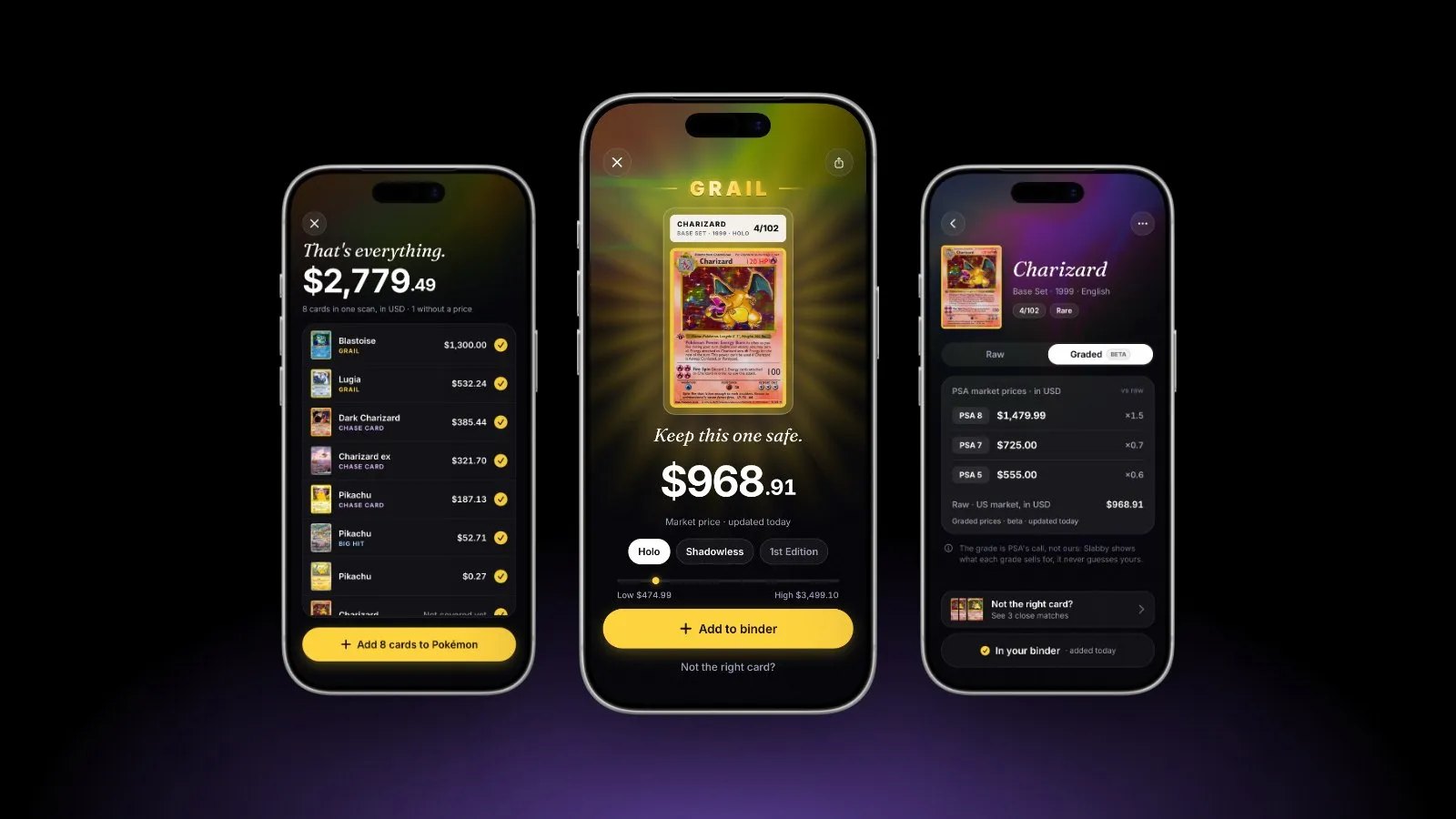
A scanner like Slabby recognizes which card you are holding and shows its market value, which tells you right away if a “bargain” is too good to be true. It can’t authenticate a card: a good fake looks like the real one to a camera. Use it to know what you are looking at, then run the checks above before you pay.
Thinking about grading a genuine card? Check its centering first with our free card centering calculator.